 Support
 Domain & Login
 Blog
Move from Data Centre to Cloud
Assess and migrate physical servers, VMware, Hyper-V, VPS or hosted infrastructure through a structured cloud migration roadmap.
Explore More →India’s Leading Domain & Web Hosting Provider



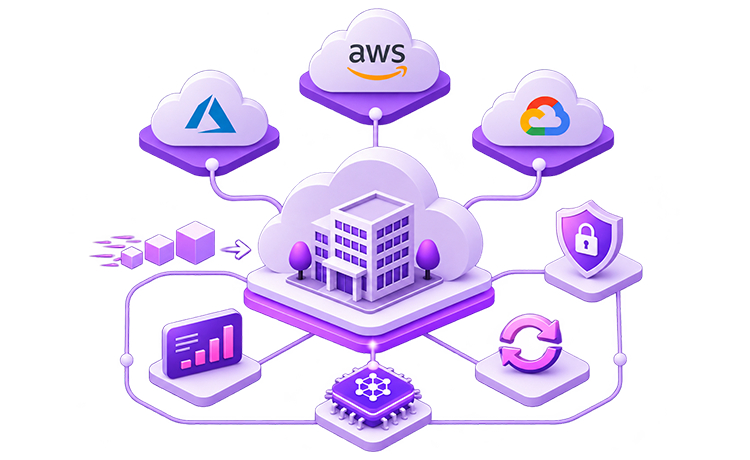
Move beyond conventional infrastructure with cloud solutions designed around applications, data, security, performance and business objectives. NTSPL helps organizations assess, migrate, modernize, secure, manage and optimize workloads across AWS, Microsoft Azure and Google Cloud. From enterprise applications and SAP to websites, disaster recovery, analytics and Generative AI, the objective is to turn cloud technology into a measurable business capability.
Start with the business problem. Each card takes you directly to the detailed NTSPL cloud capability designed around that requirement.
Assess and migrate physical servers, VMware, Hyper-V, VPS or hosted infrastructure through a structured cloud migration roadmap.
Explore More →
Improve APIs, databases, deployment and selected application components without forcing a complete rewrite.
Explore More →
Identify oversizing, idle resources, storage inefficiency, backup retention and governance gaps through FinOps.
Explore More →
Move beyond backup copies with workload-specific RPO, RTO, recovery architecture and DR testing.
Explore More →
Evaluate SAP S/4HANA and HANA infrastructure across suitable cloud platforms with HA, DR and migration planning.
Explore More →
Improve identity, network, WAF, encryption, secrets, logging and cloud-security posture.
Explore More →
Establish monitoring, incident management, backup oversight, capacity, performance and operational governance.
Explore More →
Develop RAG knowledge assistants, document intelligence, enterprise search and controlled AI agents around business data.
Explore More →
Connect ERP, production, quality, maintenance, finance and application data into governed analytical foundations.
Explore More →
Use object storage, CDN, WAF, caching and scalable application infrastructure for content-heavy digital platforms.
Explore More →
Design portals and applications for seasonal, campaign, result-day or transaction-driven demand.
Explore More →
Compare workload, technology, data, identity, security, skills and commercial considerations before choosing a platform.
Explore More →NTSPL connects advisory, architecture, migration, modernization, operations, resilience, cost governance, data and AI into one cloud transformation lifecycle.
Understand infrastructure, applications, dependencies, utilization, security, recovery and business priorities before cloud investment.
Explore More →
Move from physical infrastructure, VMware, Hyper-V, dedicated servers, VPS, private cloud or another cloud through an appropriate migration strategy.
Explore More →
Modernize through APIs, managed databases, containers, serverless and CI/CD where these create measurable value.
Explore More →
Protect identity, network, application and data while aligning recovery architecture to business-defined RPO and RTO.
Explore More →
Operate production environments through monitoring, incidents, backup oversight, capacity, performance and governance.
Explore More →
Improve visibility and accountability through rightsizing, storage, backup retention, scheduling, commitments, tagging and budgets.
Explore More →
Build governed data foundations for BI and extend them into RAG, document intelligence, enterprise search and controlled AI agents.
Explore More →Platform selection should consider application stack, data, identity, analytics, AI, operational skills, resilience and commercial context.
Broad infrastructure, storage, database, content delivery, container and AI services for diverse enterprise workloads.
Explore AWS →
Strong alignment for many Microsoft-centric enterprise environments, application modernization, identity, data and AI.
Explore Azure →
Infrastructure, Kubernetes, serverless, analytics and enterprise AI capabilities for suitable transformation programs.
Explore Google Cloud →Inventory, dependencies, utilization, risk and business criticality.
Move suitable workloads and modernize the constraints that limit value.
Monitor, protect, recover and govern the production environment.
Control cost and extend governed platforms into analytics and AI.
SAP, plant applications, corporate websites, analytics, resilience and enterprise AI around governed operational data.
Explore scenarios →
Scalable portals, security, backup, disaster recovery, observability and traffic-spike readiness for digital public services.
Read portal scenario →
Legacy modernization, API enablement, database transformation, DevSecOps, managed operations and AI integration.
Read modernization story →The value of a cloud partner is not the number of products it can list. It is the ability to connect business requirements with architecture, implementation and day-two operations.
Start with workloads, dependencies, security, recovery and outcomes before selecting services.
Evaluate AWS, Azure and Google Cloud according to fit rather than forcing every workload onto one pattern.
Connect migration with managed operations, security, backup, DR, FinOps, data and AI.
Move from a data centre, modernize legacy applications, improve application performance, reduce cloud expenditure, strengthen security, protect critical data, modernize SAP infrastructure or build enterprise AI. The cloud platform should follow the business requirement, not the other way around.
AWS supports broad infrastructure, application, database, container and AI requirements. Microsoft Azure is especially relevant to many Microsoft-centric enterprise environments. Google Cloud combines infrastructure with strong data, Kubernetes and AI capabilities. RC Cloud remains an option for simpler cloud-hosting requirements.
ASSESS → ARCHITECT → MIGRATE → MODERNIZE → MANAGE → OPTIMIZE → INNOVATE. Each stage has a different purpose, and not every customer needs to begin at the same point.
A manufacturing enterprise reaches another infrastructure refresh cycle. HANA memory demand is increasing, backup windows are tightening and the existing disaster-recovery environment would require additional capital investment. The initial question is whether to buy larger hardware. The more useful question is what SAP infrastructure the business actually needs for the next operating cycle.
Read full story →A large industrial website has accumulated years of annual reports, investor documents, images, media files and product downloads. The application server now spends significant resources delivering static content while traffic rises sharply around results, tenders and corporate announcements.
Read full story →An enterprise performs daily backups and considers its data protected. During a continuity review, management asks a different question: if the primary environment becomes unavailable this afternoon, how long will it take to restore the application, database, integrations and user access? No one can provide a tested answer.
Read full story →Every case study belongs to one specific cloud service and sets out the as-is problem, the architecture, the rollout, the results and the ROI indicator.