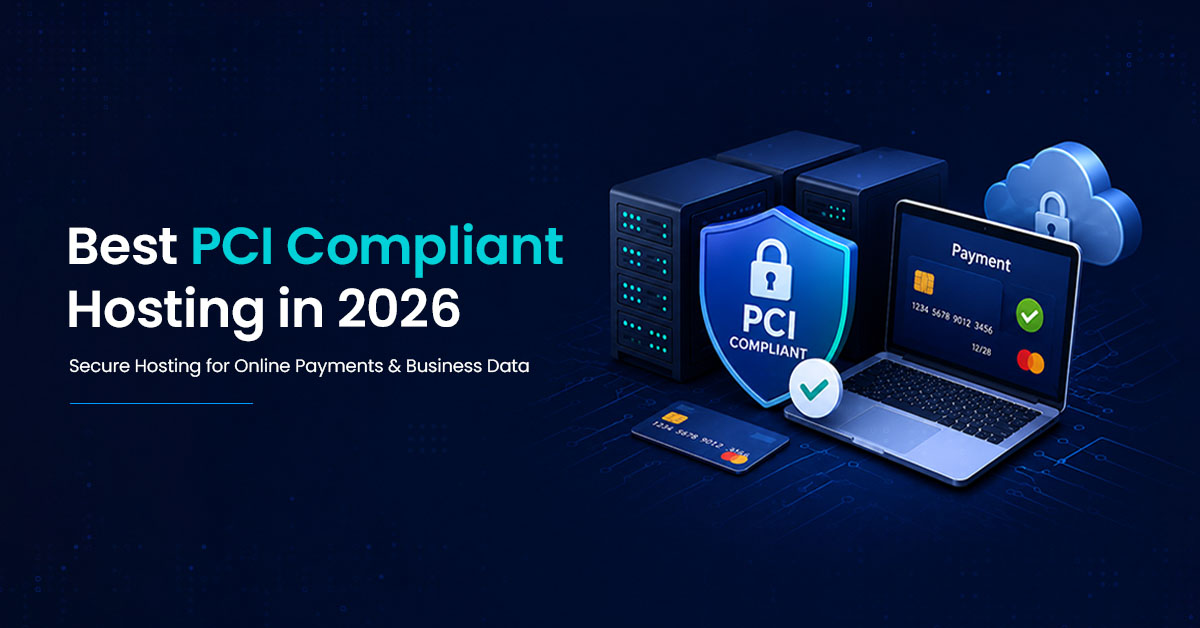
When your business accepts online payments, hosting is no longer just about speed and uptime. It becomes part of your security strategy. For eCommerce brands, SaaS platforms, healthcare portals, travel companies, and any organization that handles payment data, choosing the right hosting environment can directly impact customer trust, compliance readiness, and operational risk. PCI DSS applies to entities that store, process, or transmit cardholder data, as well as those that could affect the security of the cardholder data environment.
That is why more businesses are now searching for PCI compliant hosting rather than standard hosting alone. A strong hosting setup can support secure network segmentation, access control, monitoring, patching, vulnerability management, and other controls that help reduce exposure to payment-data risks. PCI SSC describes PCI DSS as a baseline of technical and operational requirements designed to protect payment account data.
In this guide from NTSPL, we explain what PCI compliant hosting really means, what features matter most in 2026, and how to evaluate a hosting provider before trusting it with payment-related workloads.
PCI compliance refers to meeting the requirements of the Payment Card Industry Data Security Standard (PCI DSS). These standards are designed to protect payment account data and apply broadly across merchants, processors, service providers, and other entities involved in payment processing. PCI SSC also makes clear that PCI DSS is not only for large enterprises; even smaller merchants may be in scope depending on how they handle payments.
A common misunderstanding is that “PCI compliant hosting” automatically makes a business fully compliant. In reality, hosting is only one part of the picture. Your applications, payment workflows, user access, logging, patching process, and vendor relationships all play a role. The hosting provider can support compliance, but your organization is still responsible for how systems are configured and used. PCI SSC also notes that merchants should confirm eligibility for the correct SAQ and validation path with their acquirer or payment brand.
Why PCI Compliant Hosting Matters
Businesses that process payments cannot afford weak infrastructure. A poorly secured hosting environment can expose customer data, disrupt transactions, and create serious legal and reputational consequences. A more security-focused hosting setup helps reduce attack surfaces by enforcing stronger firewalling, tighter access policies, more controlled segmentation, better monitoring, and more predictable patching and backup practices. These areas align closely with PCI DSS expectations for protecting cardholder data environments.
In 2026, this matters even more because businesses are dealing with more APIs, third-party integrations, remote admin access, and cloud-based payment workflows than ever before. The result is simple: generic hosting may be enough for a brochure site, but payment-enabled systems need a more mature security foundation.
PCI DSS in 2026: What’s Current?
As of now, the current PCI DSS release is v4.0.1, published by the PCI Security Standards Council in June 2024. PCI SSC states that v4.0.1 did not add or remove requirements from v4.0, but it did clarify wording, intent, and guidance in several areas. PCI SSC also published updated SAQs for PCI DSS v4.0.1 in October 2024, and noted that PCI DSS v4.0 was retired on 31 December 2024.
That makes it important for any new blog or buying guide in 2026 to reference PCI DSS v4.0.1, not older versions.
What Features Should You Look for in PCI Compliant Hosting?
- Strong Network Security
A PCI-ready hosting environment should support properly configured firewalls, restricted inbound and outbound traffic, and clear segmentation between public systems and sensitive workloads. The goal is to minimize the scope of systems that can affect payment data. A provider that offers dedicated network controls, private VLANs, or isolated environments is generally better positioned than one offering only basic shared hosting.
- Secure Access Control
Not every user should have access to production systems, and not every administrator should have full privileges. A good PCI-oriented hosting partner should support role-based access, least-privilege principles, secure remote administration, and strong authentication controls. PCI DSS v4.0.1 also includes clarified guidance around multi-factor authentication in some cases, making identity control even more important.
- Vulnerability Management and Timely Patching
A provider should have a clear process for vulnerability remediation, patch deployment, and system hardening. PCI SSC’s v4.0.1 clarification around applying patches within 30 days for critical vulnerabilities reinforces how important disciplined patch management remains.
- Logging, Monitoring, and Incident Visibility
You should be able to see what is happening in your environment. That means log retention, audit trails, suspicious activity monitoring, and support for incident investigation. Hosting without visibility makes compliance harder and security response slower.
- Encryption Support
A secure hosting environment should support encryption in transit and help you maintain secure key and certificate practices. Depending on your architecture, encryption at rest may also be relevant. The exact implementation will vary, but the hosting platform must not become the weak link.
- Backup and Recovery Controls
Backups are not only about availability; they are also part of resilience. For payment-related systems, you need backup routines that are protected, tested, and recoverable without introducing additional risk.
- Compliance Documentation and Shared Responsibility Clarity
One of the biggest advantages of a mature hosting provider is transparency. The provider should clearly explain which layers they manage, which controls remain with the customer, and what documentation or attestations they can share. This is especially useful when preparing for assessments, SAQs, or discussions with acquiring banks and assessors. PCI SSC’s merchant guidance emphasizes understanding the correct validation path and requirements for your environment.
Is Shared Hosting Enough for PCI Compliance?
In many cases, shared hosting is not the preferred choice for payment-sensitive environments. It may be acceptable only in very limited scenarios, depending on how payments are handled, whether cardholder data touches your systems, and which SAQ eligibility criteria apply. If your site directly handles payment pages, scripts, or cardholder data-related components, a more isolated environment such as VPS, cloud, or dedicated infrastructure is usually the safer path. PCI SSC also notes that there are multiple SAQs for different environments and eligibility matters.
For most growing businesses, the practical recommendation is to avoid relying on basic shared hosting if payment security is a priority.
PCI Compliant Hosting vs Regular Hosting
Regular hosting is usually designed around affordability, convenience, and general website performance. PCI compliant hosting, by contrast, is evaluated through a security lens. It places more emphasis on environment isolation, secure administration, vulnerability management, logging, controlled access, and compliance support.
In other words, regular hosting helps you get online. PCI-focused hosting helps you stay online securely while supporting a payment-data environment.
How to Choose the Right PCI Compliant Hosting Provider
When comparing providers, do not focus only on price. Ask practical questions:
- Does the provider support isolated environments for payment-related workloads?
- What security controls are managed by the provider, and what remains the customer’s responsibility?
- Are logging, monitoring, backup, and patching processes clearly defined?
- Can the provider explain how its infrastructure supports PCI DSS requirements?
- Does the provider offer assistance for audits, security reviews, or technical remediation?
- Will the environment scale as your payment volume and compliance obligations grow?
A provider that cannot answer these questions clearly may still be a good host for general websites, but not necessarily for a payment-sensitive platform.
Important Note for Businesses
Using a PCI-aware hosting provider does not automatically certify your entire business as PCI compliant. Compliance depends on the full environment, including applications, plugins, admin practices, payment integrations, internal policies, and third-party services. PCI SSC highlights that all entities involved in payment processing can be in scope, and validation requirements can depend on your merchant/acquirer relationships and environment type.
That is why businesses should treat hosting as one pillar of compliance, not the whole structure.
Conclusion
In 2026, choosing PCI compliant hosting is less about finding a “label” and more about selecting infrastructure that genuinely supports payment security. The right provider should help you build a safer environment through stronger access control, better monitoring, disciplined patching, and clearer compliance support.
For businesses planning to launch or upgrade a payment-enabled platform, the smart approach is to evaluate hosting from both a performance and compliance perspective. Security, scalability, and clarity of responsibility should all be part of the decision.
At NTSPL, we recommend treating PCI readiness as a long-term operational strategy, not a one-time checkbox. The hosting layer matters, but the best outcomes come when infrastructure, application security, and compliance processes work together.
Need secure hosting guidance for your payment-enabled website or application?
NTSPL helps businesses evaluate hosting, security, and infrastructure requirements for modern digital platforms. Connect with our team to explore secure, scalable, and business-ready hosting solutions.
FAQ:
- Does PCI compliant hosting mean my website is fully PCI certified?
No. Hosting can support PCI requirements, but full compliance depends on your complete environment, including applications, processes, integrations, and operational controls.
- What is the latest PCI DSS version?
PCI SSC published PCI DSS v4.0.1 in June 2024, and updated SAQs for v4.0.1 were published in October 2024.
- Do small businesses also need PCI compliance?
Yes. PCI SSC states that PCI DSS applies to merchants regardless of size, though validation and reporting requirements can vary by payment brand and acquirer.
- Is VPS or dedicated hosting better for PCI-sensitive workloads?
In many cases, yes. More isolated environments generally offer better control and security than basic shared hosting for payment-related systems.